03 / Materials research
Laterite mortar
Material questions. Measurable evidence.
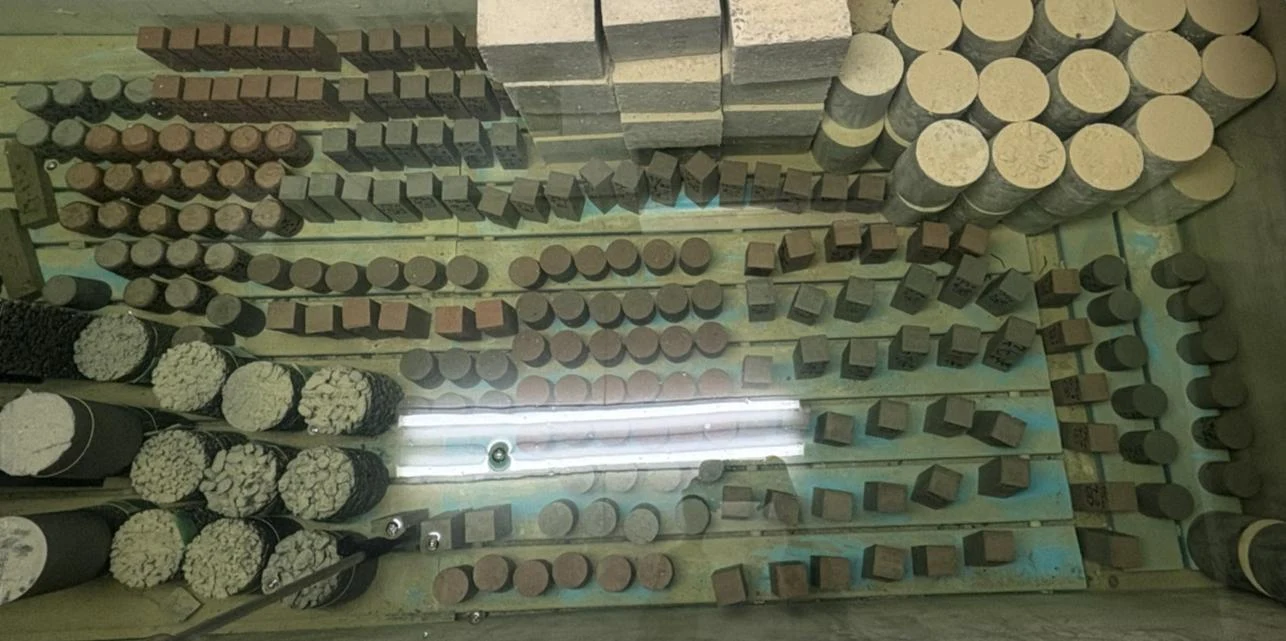
252
mortar specimens
produced
The project
An experimental study of laterite sand as fine aggregate: 252 specimens, controlled replacement ratios, and a careful reading of strength, density and water absorption.
The paper behind
the portfolio.
Experimental Study on Properties of Mortar Using Laterite Sand as Fine Aggregate
Sengly Silamongkul · Mie University, Faculty of Engineering, Architecture Course. Supervision: Prof. Noriyuki Mita and Asst. Prof. Bunka Son.
English abstract
日本語概要
Read the full thesis on this page
For a larger view or if your browser cannot display the paper, use the Read PDF link above.
The abstract downloads contain both languages in one original eight-page document. The full thesis includes the mix table, test procedures, specimen records and calculation tables.
01Can a different sand
Can a different sand
change the material?
The study investigates laterite sand as a replacement for conventional fine aggregate in mortar, with potential relevance to Cambodian construction. The central question is whether useful mechanical performance can be retained as the aggregate changes.
The experiments used Japanese tennis-court laterite as a proxy. This distinction matters: the results describe the tested laboratory material, and do not directly establish the performance of laterite sourced in Cambodia.
The work connects preparation and testing with interpretation. Compressive, flexural and splitting tensile strength were considered alongside hardened density and water absorption, so the material could be assessed through several properties.
The laterite contained more fine particles than the comparison sand. The thesis considers their possible contribution to water demand, compaction and pore filling.
02252 specimens.
252 specimens.
A structured comparison.
Five replacement levels were compared by mass of fine aggregate: 0%, 25%, 50%, 75% and 100%. Three cement-to-aggregate series were tested at corresponding water/cement ratios, with measurements at 7 and 28 days.
A second series used 100% laterite while replacing 15% of cement with either fly ash or blast-furnace slag. These mixes were compared with the plain binder group. The 252 total covers the prisms and cylinders made for the study.
0%25%50%75%100%
Mix proportions
| Series | Cement : aggregate | Water/cement |
|---|---|---|
| 01 | 1 : 1 | 0.60 |
| 02 | 1 : 2 | 0.70 |
| 03 | 1 : 3 | 0.80 |
Preparation & curing
- MixDry mix for 1 minute; wet mix for 3 minutes.
- Cast40 × 40 × 160 mm prisms and Ø50 × 100 mm cylinders.
- CureDemould after 24 hours; water-cure at 20°C.
- CompareTest at 7 and 28 days and analyze the measured properties.
03
Inside the laboratory.
The full thesis records the practical decisions behind the test series. Workability trials at full laterite replacement informed the final water/cement ratios, before the specimens were cast and tested.
These ratios varied with the aggregate-to-cement series. A comparison between the three groups therefore combines changes in both paste content and water content.
Control segregation
The initial W/C of 0.75 was too fluid. Reducing it to 0.60 produced a more cohesive mixture for casting.
Balance the water
A preliminary spread of 216 mm at W/C 0.75 prompted a reduction to 0.70 in the final series.
Enable placement
The preliminary spread was only 105–107 mm. W/C was increased to 0.80 to improve placement and compaction.
Preliminary workability trials: full thesis, PDF page 26. These are reported trial observations, not a formal equivalence between the mixtures.
From specimen to strength
Prisms were tested in three-point bending over a 100 mm span. The broken halves were then tested in compression using 40 × 40 mm loading plates. Cylinders were used for splitting tensile tests.
Two compressive readings could be obtained from the halves of one prism. Distinguishing specimens from readings keeps the experimental record clear.
Conditioning for physical tests
Saturated surface-dry mass was recorded on days 6 and 27. Specimens were then oven-dried at 105°C for 24 hours for dry-mass measurements at 7 and 28 days.
Dry density uses dry mass and specimen volume. Water absorption compares the saturated surface-dry and dry masses relative to dry mass.
04Read the response
Read the response
across properties.
The plain-mix series showed different responses in absorption, bulk density and mechanical strength. The original plots are retained here so the trends can be read within each mix and curing age.
In the legends, the three numbers describe cement:aggregate ratio, water/cement ratio and curing age. “1w” means 7 days; “4w” means 28 days. N/mm² is numerically equivalent to MPa.
Absorption
Absorption generally decreased with increasing laterite replacement. The thesis proposes that fine particles may interrupt the connected pore network; that explanation was not verified by direct microstructural measurement.
Density
Bulk density declined slightly. Compaction and entrapped air are discussed as possible contributors. The direction of this trend differs from the strength response, which makes density alone an incomplete guide to performance.
Compression
The response depends on mix proportions. The full thesis describes strength retention in the rich 1:1 series at W/C 0.60, and weaker performance in lean mixes with less paste. Full replacement should be read as a result for selected laboratory mixtures, rather than a general recommendation.
Flexure
Bending strength showed a modest upward tendency. The thesis interprets rough aggregate surfaces and mechanical interlocking as possible contributions to the bond with cement paste.
05 / Binder modification at 100% laterite
What happens when
the binder changes?
≈54MPa · reported peak compressive strength
in a slag-modified laboratory mix
in a slag-modified laboratory mix
The second comparison replaces 15% of cement with fly ash (FA) or blast-furnace slag (BF). The thesis reports the strongest compressive response in the slag-modified series, while the other strength measures show why a binder should be evaluated across several properties.
Compression
BF outperformed the corresponding plain and FA series in compression. The reported peak of approximately 54 MPa belongs to a particular laboratory mix, rather than every laterite mixture.
Different measures
FA showed a small flexural advantage in the W/C 0.60 group. BF improved splitting tensile performance. The comparison supports looking beyond a single headline strength value.
Proposed explanation
The thesis discusses internal curing, pore refinement and mechanical interlocking. These are interpretations of the measured response, rather than direct observations of the microstructure.
Chart legend: N = plain binder; FA = fly ash; BF = blast-furnace slag. 1W = 7 days; 4W = 28 days.
06Evidence needs
Evidence needs
a careful reading.
Comparing density and absorption with compressive strength helps separate two different relationships in the dataset. Density has a negligible fitted linear relationship, while absorption shows a clearer negative association.
The results do not prove a single governing mechanism. They identify a useful direction for further investigation and show why a visually denser material cannot simply be assumed to be stronger.
A negligible linear relationship within the tested dataset.
Higher absorption accompanies lower compressive strength. Association does not establish causation.
What the study supports
Selected laboratory mixes retained useful mortar performance at full laterite replacement. Slag modification improved compression. The work connects material choice, mix proportions and measured properties through an experimental process.
Limits and the next research step
The aggregate is a Japanese proxy, so Cambodian-source variability remains untested. Water/cement ratio changes with cement:aggregate ratio, which means comparisons across the three series combine both effects. Long-term durability, workability and field consistency also require further investigation.
A next stage would repeat controlled testing with Cambodian laterite and examine source variability and durability before drawing conclusions about local application.
My contribution and source material
I prepared specimens, carried out laboratory testing, analyzed data and presented technical findings under university supervision at Mie University. The thesis credits Prof. Noriyuki Mita and Asst. Prof. Bunka Son as supervisors.
Source: Sengly Silamongkul, Experimental Study on Properties of Mortar Using Laterite Sand as Fine Aggregate, 2025–2026. The selected numbered charts are original extracts from the bilingual abstract. The full thesis provides the expanded discussion, procedures and calculation tables. The total of 252 specimens was confirmed by the author.
07A record of
A record of
making and testing.
The specimen photographs extend the material story beyond the plotted results. The original pool photograph at the top of this page records the specimens before testing; these images show groups after testing.
The complete thesis retains the measured and calculated data, including the 7-day and 28-day records. Readers can follow the evidence back from the selected plots to the original tables.